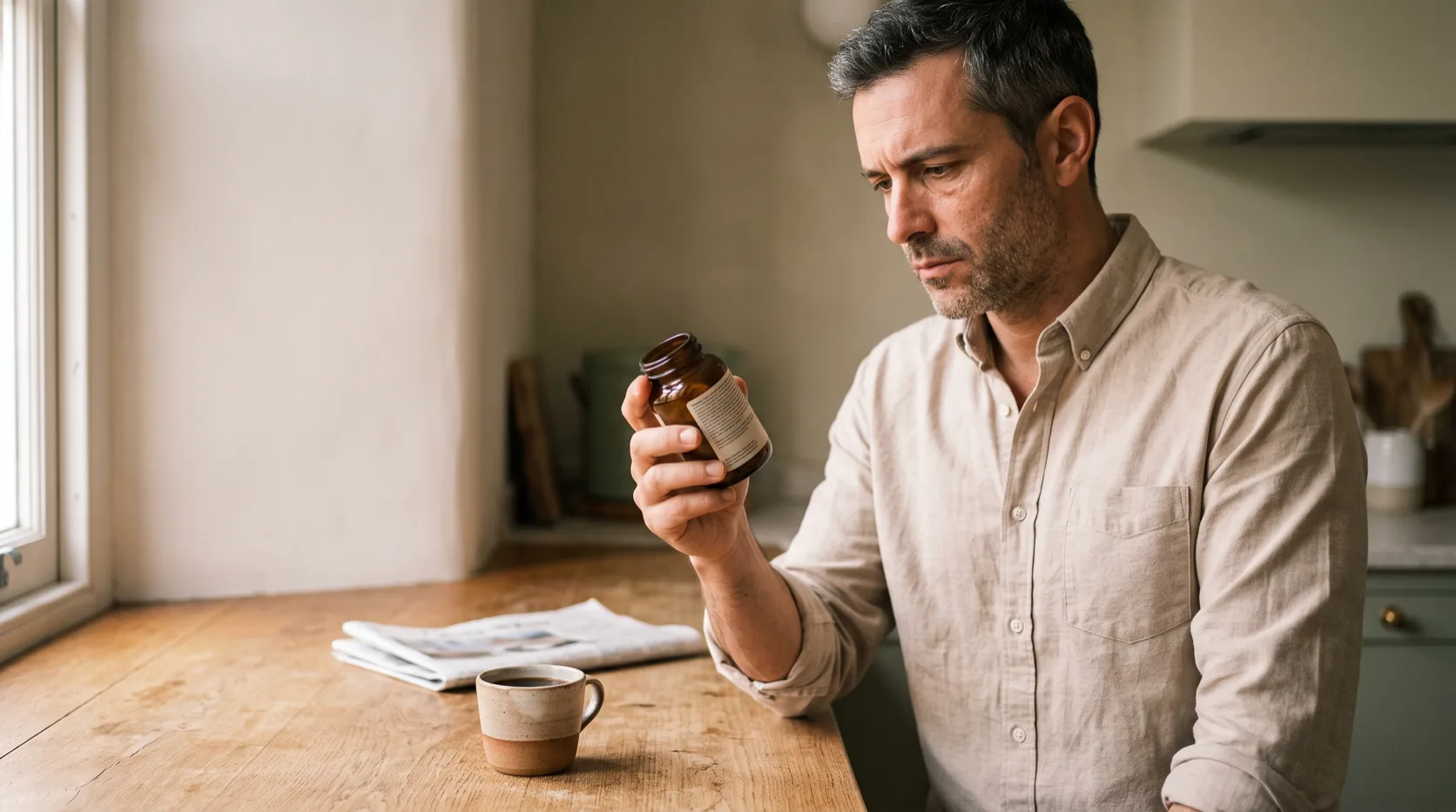
There may be a jar of taurine in your kitchen from the summer of 2023, when the headlines said a cheap amino acid had made laboratory animals live longer. Here is the part nobody told you: the scientists who wrote that paper ended it by saying somebody should now test this in humans.
Somebody did. A trial that measured exactly this finished collecting its data in November 2025, at one of the labs behind the original paper. Nine months later its results have not been published. In the meantime, two separate teams knocked out the assumption the whole idea was built on.
What did the 2023 study actually find?
It was not a small paper, and it was not one lab. It ran in worms, mice and monkeys, and its author list runs past thirty institutions, among them the Buck Institute for Research on Aging, the University of Washington and the Wellcome Sanger Institute.
The animal results were real. Mice given taurine lived longer and stayed healthier. Monkeys got healthier.
The human part was different. Nobody gave taurine to a person. Researchers compared different people at one moment in time and found that those with less taurine in their blood had more age-related disease. That is a correlation, and the authors said so. Their closing line asks for what did not exist yet: clinical trials "seem warranted to test whether taurine deficiency might drive aging in humans."
What changed in 2025?
Somebody followed the same people over time, instead of comparing different people of different ages.
In June, a team led from the US National Institute on Aging measured taurine across three groups on two continents: the Baltimore Longitudinal Study of Aging, a cohort in Mallorca, and one in Atlanta run with Emory University. Taurine went up with age, or stayed flat. Not down. Same in monkeys and mice, the animals in the original paper.
Their sharper finding was not about the direction at all. One person’s taurine swung around so much over their own life, and differed so much between people of the same age, that it cannot really tell you anything about anybody.
Four months later an independent group at the Université du Québec à Montréal measured 137 men aged 20 to 93. No link between taurine and age, muscle mass, strength, physical performance, or how well the mitochondria in their muscle worked.
So was the first study wrong?
Not exactly. Vijay Yadav, the senior author of the 2023 paper, has a specific answer rather than a brush-off. His study looked at people from birth to sixty. The 2025 one looked at thirty to ninety. And roughly seventy per cent of the fall he found happens between birth and thirty, before the newer study starts counting. After thirty, he says, levels hold steady, then drift up slightly after sixty. Which is close to what the 2025 team measured. If he is right, both sides are describing the same curve from different ends.
A second limit sits in neither press release. All of these studies measured taurine in blood. Most of your taurine is inside cells, in muscle and brain, at far higher concentrations. Nobody has followed tissue taurine in people as they age. So "taurine does not fall with age" is a smaller claim than it sounds. It is about a blood test, in adults.
Has anyone given taurine to people and measured what happened?
Three times. What each one measured matters more than that it happened.
The largest gave 6 grams a day to 236 people over 75 around hip surgery. What it set out to change was deaths and complications. It did not change them. A smaller one gave 1.5 grams a day to 24 women aged 55 to 70 for 16 weeks. It is titled as an anti-aging trial, and what went up was one antioxidant enzyme in the blood, which is not aging. A third gave taurine to 48 older women alongside exercise. Only the group doing both improved on the memory test. Taurine alone did move two inflammation markers, just not the one that measures thinking.
Three trials, none of them measuring whether anyone aged more slowly.
The trial that would settle it has already finished
In 2024 the Technical University of Munich, one of the labs on the 2023 paper, started the trial it had called for. Ninety people aged 55 to 75, four grams a day or a placebo, six months. What it set out to measure was biological age: not how many birthdays you have had, but how worn the body looks from the inside. They measured it twice over, once from chemical tags on the DNA and once from proteins in the blood.
It finished collecting data on 13 November 2025 (NCT06613542). The results are not published.
Rutgers, where Yadav works now, is listed as a collaborator on it, alongside Stanford. Yadav has said he helps oversee a trial of four grams a day for six months in older adults: this one's design.
A second trial is running in Hong Kong, giving 3 grams a day to healthcare workers for six months (protocol published 2026). It tracks biological age too, though what it is built to detect is blood sugar control.
So: not debunked. Answered soon, by the people who disagree about it.
Where does the three-gram dose come from?
A mouse. The doses you see recommended are scaled from what mice drank, and no human trial has compared one anti-aging dose against another.
Food puts it in perspective. Seafood and dark meat carry the most, white meat and beef much less, plants essentially none. When researchers compared vegans with meat-eaters, the vegans ate no taurine at all, and their blood levels were only slightly lower. Your body makes its own and holds the level fairly steady. That is a hard thing to top up by swallowing more, and it may be why a can of Red Bull, at 1,000 mg, has never made anyone younger.
Why is it still sold for aging, then?
Because nothing about the business depended on the science being right. Taurine is a cheap bulk ingredient already made at industrial scale for energy drinks and animal feed. Selling it for aging never required a new factory or a clinical programme. A label changed, so when the science moved there was nothing to unwind.
The 2023 paper says plainly that Columbia University filed patent applications naming Yadav as an inventor. Universities do that with almost anything their researchers find, and he put it in the paper himself rather than leave someone else to dig it up. Whether it colours how you read him is your call. We would just rather you knew.
Is it safe?
As far as anyone has measured, yes. European food-safety regulators reviewed taurine in energy drinks in 2009 and found no safety concern at realistic intakes. France banned Red Bull for twelve years partly over taurine, then lifted the ban without new evidence of harm.
The honest caution is not the taurine, it is what it usually arrives in. Energy drinks bring caffeine and sugar, and those are the ingredients with a track record. And nobody has tested 3 to 6 grams a day for years in healthy people, so a clean record at ordinary intakes is not a tested one at supplement doses.
What should you do tomorrow?
If you already take taurine: nothing here says stop. It is cheap, it looks safe at these amounts, and the trial that could justify it reports soon. Finish the jar if you want to.
If you do not take it: there is no reason to start yet. Wait for Munich.
Either way, the thing worth doing tomorrow is not in a jar. Sleep, walking and lifting something heavy all have human trials behind them, which is more than taurine can say. We have been just as blunt about the last supplement everyone was talking about and about a drug people hope slows aging.
We will update this page when Munich publishes. When we get something wrong, we say so in our editorial standards.