A first-hand review, after 35 days of testing. The headset is strange enough on its own: it lets you move a ball on a screen with nothing but your concentration. But the real surprise was when it worked best. My best sessions did not come on the calm, easy days. They came on my most stressful ones, the days I almost skipped the session entirely. I would sit down tense and worn out, run the ten minutes anyway, and watch the screen post some of my highest scores of the whole month.
A note before we start: this review carries affiliate links, and if you buy through one I may earn a small commission. The commission comes out of the seller's margin, not your price. Mendi sent me the headset to test as part of a partnership. They did not pay me to write it, and the verdict is my own: if it had not worked for me, this review would say so. Read the whole thing before you decide anything. Everything below is my own experience over five weeks, with my own numbers from my health-tracking devices. As a reader, you get 27% off with the code WelcomeRoy, and I share the details at the end.
What Is Mendi, in Plain Terms?
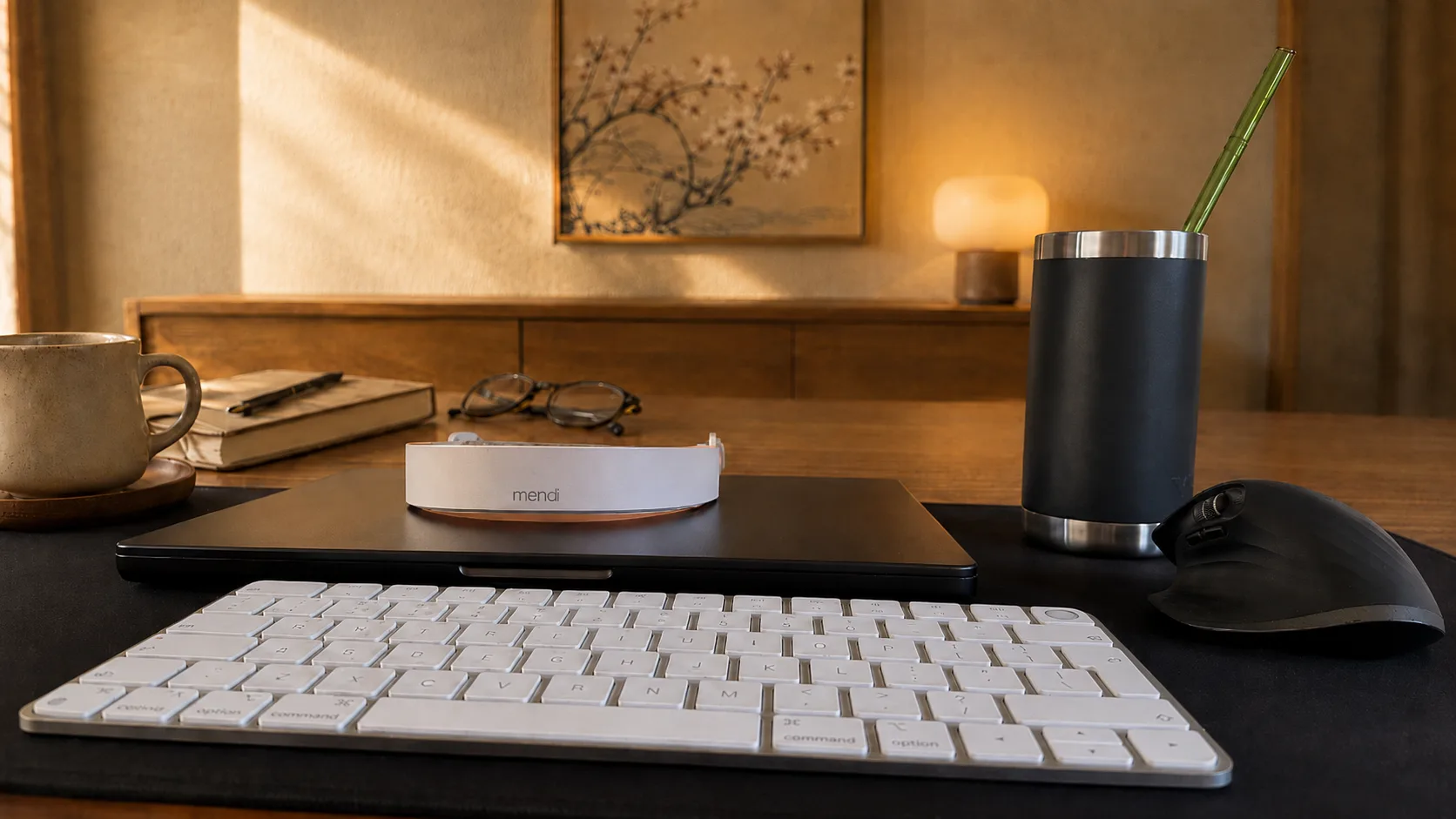
Mendi is a soft headband you wear on your forehead for a few minutes a day. A small sensor shines harmless light through your skin and reads how much oxygen-rich blood flows to the area right behind your forehead. That spot runs your focus, your calm, and your self-control (scientists call it the prefrontal cortex). That reading drives a simple game on your phone, and this is the part that got me the first time: lock your focus and the ball climbs; let your mind drift and it sinks. No buttons, no hands, just your attention doing the work. You can watch your focus on a screen and practise steering it. Training a live signal by watching it this way has a name, neurofeedback, and the light-reading method behind it, called fNIRS, is the same kind hospitals use to study the brain.
This is what makes it different from a smartwatch or a fitness ring. Those devices measure you. Mendi asks you to train. Each short session works the front of your brain on purpose, pulling more blood and oxygen to it, the way one curl works your arm. The idea is that repeating this strengthens your focus over time, the brain's version of building a muscle. It is one lever among several, and the free ones still matter most, which is what I went through in how to keep your brain sharp.
The science here is young, but it is real. In a careful trial at Japan's Tohoku University, the rigorous kind where no one knew who was getting the real training, 60 people trained twenty minutes a day for four weeks. The ones given the same kind of light-based brain feedback Mendi uses came out better at concentrating, and at holding things in mind, than the ones who trained without it. The field is young, the strongest studies are still small, and a 2026 preprint, meaning a study shared before other scientists have checked it, using a different brain-reading method (EEG) in people with ADHD, found no benefit at all. No large study of this exact headset exists yet. That Tohoku study tested the method, not the Mendi headset itself, but it is the closest solid evidence to what Mendi does, and it is exactly why I ran my own month-long test instead of trusting the marketing.
My 35-Day Routine
I built it up slowly. Weeks one and two: five minutes each morning. Week three: ten minutes. Weeks four and five: twice a day, ten minutes in the morning and ten in the evening. I was not chasing a number. I wanted to know whether a tiny daily habit would hold once life got busy, and what it would change in how I think and feel.
Worth naming: the Tohoku trial ran twenty minutes a day for four straight weeks. I only reached twenty minutes a day in my last two weeks, so for most of my test I ran a lighter dose than the study I am leaning on.
Three things changed, in rising order of how much they mattered to me.
How Do You Calm a Stressful Mind?
This is the surprise I opened with. My most stressful days produced my best sessions, again and again. The headset stopped being a productivity gadget and became my reset: ten minutes to step out of a spiral and come back level. It also became my way to switch cleanly from one task to the next, a short pause that clears the last thing before I start the next one. If you want the version that costs nothing, I wrote up a breathing pattern that settles the body in about five minutes.
How Do You Quiet a Racing Mind After a Hard Day?
A short session in the evening settled the looping thoughts after a hard day and left me readier to switch off. After busy, stressful days my mind kept running, still sorting through everything I had to do, and ten quiet minutes helped me set it down. One honest caveat, because it matters: a bright phone screen right before bed works against sleep, not for it. So I ran these eyes-closed, with the screen dimmed, earlier in the evening rather than as the last thing before lights-out. This is just how I ended up using it, not something Mendi recommends, and I share it as a personal note. But it became one of my favourite ways to use it.
How Long Does It Take to Improve Your Focus?
This was the quietest change and the most honest. I did not feel sharper in week one. The shift only showed up around week four, once the twice-a-day habit held, and even then it was quiet: I got pulled away from hard tasks less often, and I could stick with my work a little longer before my mind wandered. Real, but it builds slowly, and it was the change I would have bet against.
The One Tip I'd Pass to a New User
Around day 21 I stopped staring at the ball. I held the phone at eye height, closed my eyes for stretches, and just pictured the ball climbing. My scores jumped and stayed up. My working theory: a head bowed over a phone may pinch the blood flow to the very area you are training, and picturing the movement may wake up parts of the brain that plain staring misses. It has been my default ever since.
What Are the Downsides?
Two things are worth knowing going in. Sessions come in fixed lengths of three, five, ten, or fifteen minutes rather than anything you set yourself, though that actually keeps the routine simple. And the big one: this is a slow build, not a quick win. Neither broke the experience for me.
Did My Focus Scores Actually Improve?
My scores climbed the more I practised. The number I care about most is control time, how long I can hold the ball steady with focus alone, and at my best it reached 85 seconds, in week four. The other number is Mendi's own session score, which sits on the app's own scale rather than in any unit you could check yourself: the app keeps only each day's best, and the average of those climbed from about 80 to about 90, with my top session at 93. Both peaked in week four, the week I trained most, then eased off in a busier fifth. And here is the reason not to lean on that: I doubled my daily sessions and changed my technique within days of each other, so I cannot tell you which of the two moved the numbers, or whether it was simply five weeks of practice. One person, five weeks, so take it as a hint, not proof. I am wary of my own numbers for the same reason I am wary of biological-age tests, which I dug into here: a single reading moves around more than people think.
Who Is Mendi For?
If you want a few quiet minutes a day that leave you calmer on a hard day, help you switch cleanly between tasks, and quiet the mental noise after a long one, Mendi earns its place. It trains the one part of your brain you lean on most for focus and self-control, and it gives you something most wellness gadgets never do: a clear signal you can actually practise with. It is not a passive tracker and it is not a quick fix. The value lives in showing up, and that part is on you.
Would I Keep Using It?
Yes. Mendi suggests it takes about eight weeks and I tested five, so I have only climbed part of the hill. Think of the front of your brain like a muscle: the real, lasting change comes from months of steady reps. Even in five weeks I found genuine, daily use, the stress reset and the calmer evening wind-down, and the headband is staying in my daily rotation precisely because the best part is meant to arrive later. I will publish a longer update in a few months and tell you honestly whether the focus change held, grew, or faded.
One last thing I came to appreciate: you pay once. Plenty of gadgets pull you in with a low price, then quietly charge you every month for years until the real cost is far higher. Mendi does not do that. The app comes included, and their own site states zero subscription fees and a 60-day money-back guarantee. Those are their terms rather than mine, so read them before you order, and check how a return works from your country. The honest asterisk on "pay once" is that the training runs through an app, so it lasts as long as the company keeps that app working, which is true of every connected device.
Mendi runs around $349, though the price moves and they often run promotions that bring it lower, so it is worth checking the current deal through my link. If you want to train the same way, this is the headset I use, and plan to keep using: Mendi. That is my affiliate link, as I mentioned up top.
Your reader discount: use the code WelcomeRoy at checkout for 27% off the Mendi headset, a little better than the usual discount on their site. The codes do not combine, so use WelcomeRoy or whatever offer is on the site, whichever saves you more.
What to do tomorrow
Before you spend anything, find out whether you will actually show up.
Tomorrow, pick a moment you can predict. After lunch, the first hour back home, whatever yours is. Set a timer for five minutes, the same five I started with, and sit through them with no screen. Eyes open or shut, thinking whatever you like. If sitting still leaves you feeling worse rather than calmer, open your eyes, look around the room and stop. That happens to some people, and it is not a failure of yours.
Do it again the next day, and the next, for five days.
Four or five days out of the five and you can hold the slot, which is the part no device does for you. Two or three and the slot is the thing to fix first, and you found that out for nothing.
Hold the slot, and the headset adds what five empty minutes cannot: a signal to steer. That is the point where I would buy it, and I did. The link and the WelcomeRoy code are just above.
And if you would rather test the real thing than my stand-in for it, you can. Mendi states a 60-day money-back guarantee, so the five days above are a way to save yourself the trouble, not the only way to find out. Either way you get an answer. One of them is just cheaper.
Scientific References
This article synthesizes research from the following institutions and studies. All content is derived from peer-reviewed scientific literature and leading research centers.
• USC Leonard Davis School of Gerontology (Dr. Mara Mather), HRV biofeedback and cortical volume. Funded by NIH R01AG057184; ClinicalTrials.gov NCT03458910.
• Yoo et al., International Journal of Psychophysiology: "Heart rate variability (HRV) changes and cortical volume changes in a randomized trial of five weeks of daily HRV biofeedback in younger and older adults" (2022). PMID 36030986. DOI 10.1016/j.ijpsycho.2022.08.006. CORRECTED 2026-08-10 against the full text (PMC11195601): N=193 RANDOMISED (121 younger, 72 older), 162 completed all 7 weeks, 151 had both scans, N=145 in the ROI analysis — the old "N=162 enrolled" here was wrong. Left orbitofrontal cortex volume increased in the Osc+ arm relative to the Osc- arm, F(1,140)=8.33, p=.005 (Osc+ +0.55%, Osc- -0.96%); right OFC showed no effect, F(1,140)=1.36, p=.246. Pre-specified 2-ROI analysis, not a whole-brain search. ALSO CORRECTED: the old row said "the comparison group also did paced biofeedback" — it did NOT. Methods, verbatim: Osc- participants were "asked to come up with five strategies to lower heart rate and heart rate oscillations" and received an inverted "calmness" score; only the Osc+ arm used paced breathing at resonance frequency. It is still a between-arm difference, not absolute growth, and the paper does not use the word "neurogenesis". No independent lab has replicated it.
• Nashiro et al., Applied Psychophysiology and Biofeedback: "Effects of a Randomised Trial of 5-Week Heart Rate Variability Biofeedback Intervention on Cognitive Function: Possible Benefits for Inhibitory Control" (2023). PMID 36030457. DOI 10.1007/s10484-022-09558-y. N=165. The primary result was NULL: the intervention did not significantly improve inhibitory control, working memory or processing speed. Only a secondary correlational analysis was positive, and the authors call for replication.
• HeartMath Institute, emWave Pro biofeedback hardware and software — the instrument used to pace breathing and measure HRV in the USC trials above. HeartMath sells HRV devices; listed for provenance, not as independent evidence.
• Laukkanen et al., Age and Ageing: "Sauna bathing is inversely associated with dementia and Alzheimer's disease in middle-aged Finnish men" (Dr. Jari Laukkanen, University of Eastern Finland, 2017). PMID 27932366. DOI 10.1093/ageing/afw212. Prospective cohort (KIHD), 2,315 men aged 42-60, median follow-up 20.7 years, 204 dementia and 123 Alzheimer cases. Alzheimer hazard ratio 0.35 (95% CI 0.14-0.90) for 4-7 sessions per week vs 1. Exposure recorded was FREQUENCY only; the study measured neither temperature nor session length.
• Erickson et al., PNAS: "Exercise training increases size of hippocampus and improves memory" (run at the University of Illinois; first author then at Pittsburgh; 2011). PMID 21282661. DOI 10.1073/pnas.1015950108. Randomized trial, 120 older adults, 1 year; anterior hippocampal volume +2.12% left / +1.97% right vs -1.40%/-1.43% in stretching controls. CAUTION on the title: the paper's own Results state the exercise group "did not improve performance above that achieved by the stretching control group" on spatial memory (Time x Group F(1,102)=0.67, P<0.40), and serum BDNF did not rise more in exercisers (F(1,97)=1.42, P<0.23). Pooling 8 later trials in 554 people found no significant volume effect (PMID 37943486).
• Dinoff et al., European Journal of Neuroscience: "The effect of acute exercise on blood concentrations of brain-derived neurotrophic factor in healthy adults: a meta-analysis" (2017). PMID 28493624. DOI 10.1111/ejn.13603. 55 studies; a single exercise session raised peripheral blood BDNF (SMD 0.59), with the effect present in men and not in women.
• Singh-Manoux, Kivimaki et al., BMJ: "Timing of onset of cognitive decline: results from Whitehall II prospective cohort study" (2012). PMID 22223828. DOI 10.1136/bmj.d7622. University College London (Department of Epidemiology and Public Health) with a co-author at the University of Oxford Department of Psychiatry. 7,390 civil servants; reasoning scores already declining at ages 45-49.
• Sabia, Kivimaki, Singh-Manoux et al., Nature Communications: "Association of sleep duration in middle and old age with incidence of dementia" (2021). PMID 33879784. DOI 10.1038/s41467-021-22354-2. University College London / Whitehall II. 7,959 participants, 25-year follow-up, 521 dementia cases; 6 hours or less at age 50 and 60 associated with higher dementia risk (HR 1.22 and 1.37); persistent short sleep about 30% higher risk. Observational.
• Sabia, Ebmeier, Kivimaki, Singh-Manoux et al., BMJ: "Association of ideal cardiovascular health at age 50 with incidence of dementia: 25 year follow-up of Whitehall II cohort study" (2019). PMID 31391187. DOI 10.1136/bmj.l4414. University College London with a co-author at the University of Oxford Department of Psychiatry. 7,899 participants, 347 dementia cases; hazard ratio 0.89 per 1-point rise in the Life Simple 7 score. Observational.
• Kang, Manson et al., Scientific Reports: "Effect of vitamin D on cognitive decline: results from two ancillary studies of the VITAL randomized trial" (Brigham and Women's Hospital / Harvard Medical School, 2021). PMID 34853363. DOI 10.1038/s41598-021-02485-8. 2,000 IU/day cholecalciferol, 4,218 participants aged 60+. No effect on cognitive decline (pooled mean difference 0.01, p=0.39) and NO interaction with baseline 25-hydroxyvitamin-D level.
• Pham, Waterhouse, Neale et al., Journal of the American Geriatrics Society: "Vitamin D supplementation and cognition - Results from analyses of the D-Health trial" (QIMR Berghofer, 2023). PMID 36715270. DOI 10.1111/jgs.18247. 60,000 IU monthly for 5 years; cognition assessed in 3,887 participants aged 70+. No effect (mean difference 0.04; odds ratio for cognitive impairment 1.00).
• Smith A.D. et al., PLoS ONE: "Homocysteine-lowering by B vitamins slows the rate of accelerated brain atrophy in mild cognitive impairment: a randomized controlled trial" (VITACOG, Oxford Project to Investigate Memory and Ageing, University of Oxford, 2010). PMID 20838622. DOI 10.1371/journal.pone.0012244. n=271, 168 completed the MRI arm; whole-brain atrophy 0.76%/y on treatment vs 1.08% on placebo, with the benefit confined to participants with baseline homocysteine above ~11-13 umol/L. Declared conflict: A.D. Smith is named inventor on University of Oxford patents on this use and could benefit financially.
• Clarke R. et al. (B-Vitamin Treatment Trialists' Collaboration), American Journal of Clinical Nutrition: "Effects of homocysteine lowering with B vitamins on cognitive aging: meta-analysis of 11 trials with cognitive data on 22,000 individuals" (Clinical Trial Service Unit, University of Oxford, 2014). PMID 24965307. DOI 10.3945/ajcn.113.076349. B vitamins lowered homocysteine by 26-28% and had no significant effect on any cognitive domain or on global cognition. Cite alongside VITACOG above; the two Oxford results are the honest pair.
• Sydenham, Dangour & Lim, Cochrane Database of Systematic Reviews: "Omega 3 fatty acid for the prevention of cognitive decline and dementia" (2012). PMID 22696350. DOI 10.1002/14651858.CD005379.pub3. 3 trials, 3,536 participants at final follow-up; no benefit of omega-3 supplementation on cognitive function in cognitively healthy older people.
• Knekt et al., Preventive Medicine Reports: "Does sauna bathing protect against dementia?" (Finnish Mobile Clinic Follow-up Survey, 2020). PMID 33088678. DOI 10.1016/j.pmedr.2020.101221. n=13,994 men AND women aged 30-69, 39-year follow-up, 1,805 dementia cases. THE DOSE STUDY: unlike PMID 27932366 it analysed temperature and session length against dementia. Verbatim: "The most favorable sauna temperature for dementia protection was 80-99 degrees C" (full-model HR 0.94, 0.85-1.04 vs under 80C, so not statistically clear) and "For high sauna temperatures of 100 degrees C or more, an elevated risk was revealed during the first 20 years (HR = 2.04, 95% CI = 1.32-3.15)", attenuating to 1.14 (0.92-1.43) across the full 39 years. Session length effectively null: 5-14 min HR 0.90 (0.80-1.01), 15+ min 0.87 (0.72-1.05). Frequency 9-12/month HR 0.81 (0.69-0.97). Observational. THIS CITATION FALSIFIED the article's previous claim, live in FAQPage JSON-LD since April, that no evidence-based sauna temperature or duration existed.
• Livingston et al., The Lancet: "Dementia prevention, intervention, and care: 2024 report of the Lancet standing Commission" (2024). PMID 39096926. The standing list of modifiable dementia risk factors, including hearing loss. NOTE: cite for the existence and membership of the list. The population-attributable-fraction percentages have NOT been read off the paper here — read it before quoting one.
• Lin et al., The Lancet: "Hearing intervention versus health education control to reduce cognitive decline in older adults with hearing loss in the USA (ACHIEVE): a multicentre, randomised controlled trial" (2023). PMID 37478886. n=977, aged 70-84, untreated hearing loss, 3-year follow-up. PRIMARY ENDPOINT NULL, verbatim: "The hearing intervention did not reduce 3-year cognitive decline in the primary analysis of the total cohort." A prespecified analysis found an effect in the higher-risk ARIC subpopulation but not the healthier de novo cohort. NEVER describe this as a positive trial without naming the null primary endpoint — an adversarial reviewer did exactly that on 2026-08-10.
• Balbim, Erickson et al., GeroScience: "Aerobic exercise training effects on hippocampal volume in healthy older individuals: a meta-analysis of randomized controlled trials" (2024). PMID 37943486. 8 RCTs, n=554. NULL: SMD 0.10 (95% CI -0.01 to 0.21, p=0.073). "AET does not seem to impact hippocampal volume in cognitively unimpaired, healthy older individuals." Kirk Erickson, first author of the 2011 trial above, is a co-author on this null. Ship this beside PMID 21282661, never alone.
• Sink, Espeland et al., JAMA: "Effect of a 24-Month Physical Activity Intervention vs Health Education on Cognitive Outcomes in Sedentary Older Adults: The LIFE Randomized Trial" (2015). PMID 26305648. n=1,635, aged 70-89. No difference in global or domain-specific cognition (Digit Symbol Coding mean difference -0.01, p=.97). BUT two prespecified subgroups DID improve on executive function: participants aged 80+ (n=307) and those with poorer baseline physical performance (n=328), both p=.01 for interaction. Do not write "no benefit at all" without that clause.
• Martens et al., Alzheimer's & Dementia: "A phase-II randomized controlled pilot study of nicotinamide riboside supplementation in older adults with amnestic mild cognitive impairment" (2026). PMID 42478598. 12 weeks, null on cognitive function, NO declared conflicts of interest. Companion nulls WITH industry ties: PMID 37994989 (Orr 2024, ChromaDex-supplied drug, Brenner is ChromaDex CSO) and PMID 39817194 (Wu 2025, Tanzi holds ChromaDex equity). Three RCTs, three nulls — this is the MEASURED NULL that replaced the article's previous unfalsifiable "nobody has tested it".
• Huang et al., Neurology: "Sleep, major depressive disorder, and Alzheimer disease: A Mendelian randomization study" (2020). PMID 32817390. Bidirectional 2-sample MR, UK Biobank n=446,118. NO causal effect of sleep traits on Alzheimer's; the signal ran the OTHER way (AD genetic risk predicted shorter sleep). Ship beside PMID 33879784 — it is the causal counterweight to the observational sleep-dementia association.
• Peretti et al., Nature: "RBM3 mediates structural plasticity and protective effects of cooling in neurodegeneration" (2015). PMID 25607368. DOI 10.1038/nature14142. MRC Toxicology Unit, then at the University of Leicester; senior author Giovanna Mallucci also at the University of Cambridge. MOUSE study using laboratory cooling, not cold showers.